
How Synchronicity Works
A Cheat Sheet

I’ve had too many conversations about this, so I’m just going to put the important points here and be done with it.
First of all, I don’t love the colloquial usage of “synchronicities” as discrete events. It’s appropriate that Jung worked with a physicist to hone the idea, because synchronicity is more like gravity than anything else.
It would feel odd to say “I had a lot of gravities this week,” and then describe how I dropped my keys, went on a roller coaster, watched a stream roll downhill, and tripped over a welcome mat. Those are all instances of gravity affecting me quite noticeably — but clearly, gravity is always here, always affecting me. My whole body and everything I encounter are all arranged to interact with gravity constantly, because gravity is constantly present.
In the same way, it feels odd to me to talk about “a lot of synchronicities this week,” because synchronicity is always present. Meaning and events are always weaving together, interacting and playing with one another. We just notice it more acutely sometimes.
Secondly, synchronicity doesn’t give instructions, just information.
People will often treat a noticeable synchronicity like a road-sign, a pointer that they need to go in a certain direction. That can sometimes work, when the information environment lines up right, but it’s a dangerous assumption to make.
Navigating synchronicity is very unlike driving in a city. It’s very much closer to navigating the ocean like wayfinders. For example, wayfinders might notice two nearby birds in the east. This tells them that they’re somewhat close to land, which is great information. But it’s not nearly enough information to know what direction the land is in, if anyone lives there, if it’s safe, etc. It does, however, give them a reason to keep their senses alert for more signs of land.
For most people who track synchronicity, the attitude tends to be something close to “I saw two birds in the east this morning, it’s a sign I need to head east.”
Sometimes you get lucky and the land was, in fact, eastward. Other times, you just waste the day going the wrong direction and then wonder why the universe would trick and mislead you like that.
Third, returning to the basic definition of synchronicity as an acausal connection between inner meaning and exterior events:this connection is always present, and attuning to it in too literal or left-brained a way very easily tips into psychotic territory.
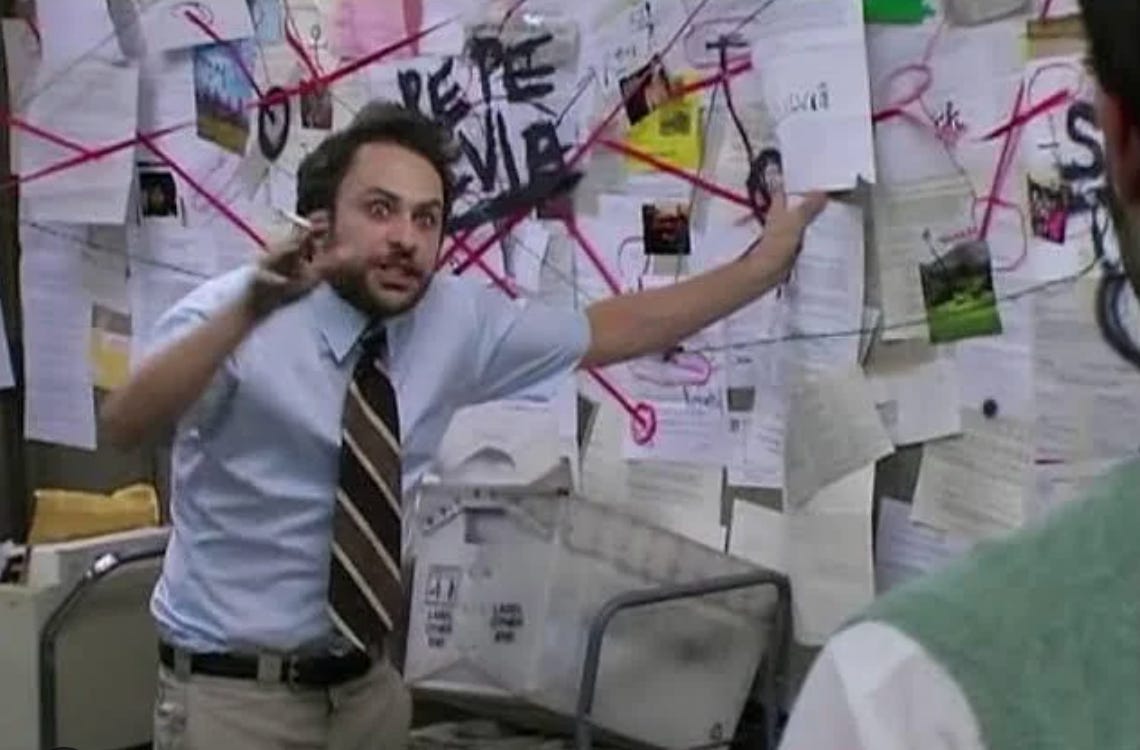
If you see two birds in the east and immediately start building a case for how the waves also seem to point east and one cloud looks like an arrow pointing east and the wind from the east sounds like a song your grandma used to hum and and and — then you should probably take a deep breath and drop the whole synchronicity thing until you can see two birds in the east and stay fully chill and grounded about it.
I’m being a bit jokey here, but this is actually a fairly serious point. If you can keep a pretty open, “right-hemisphere”, non-reactive awareness while noticing synchronicity, you’ll be grand. If you notice yourself seeing synchronicity and then reacting to it by collapsing the meaning, looking for instructions, or connecting it into your red-threaded conspiracy wall, it’s probably best to take a break and step back from the woo for a bit.
This is another topic, but closely related enough to be worth flagging here: as a general rule, all of the worst tendencies of woo-brain are actually just what happens when woo gets stuck in left hemisphere mode. If you can reliably stay in right hemisphere mode1 while engaging with woo, you’re pretty much just… noticing reality accurately.
Fourth — not quite sure how to say this one, but something like: synchronicity is a bit of a smart-ass, so learn to laugh a bit.
I could also say something like “the primal intelligence behind synchronicity has a weird sense of humor and a trickster aspect, so hold everything lightly and be ready to feel the universe giggle at your hapless little mammal existence sometimes.”
My read is that part of the dynamic here is to remind us to not take synchronicity terribly seriously. I think the primal intelligence pokes me harder the more seriously I take it. — I’m not sure about this, just a personal read.
Those are the main points, or at least the ones that I’ve repeated often enough that they’re worth collecting in one place.
Anyway, as I was typing that last paragraph, someone I haven’t talked to in weeks texted me to ask for a call so I could answer some questions about the right hemisphere — so synchronicity is still alive and kicking, that’s nice.
Also worth remembering that “right hemisphere mode” is actually “entire-brain-and-body mode,” since the main difference between right and left is that the left wants to do everything its own way, and the right wants to include all the inputs, including the left hemisphere’s insights.
I wrote something along a similar lines about synchronicity the other week :)
https://substack.com/@tuckerwalsh/note/c-194160943?utm_source=notes-share-action&r=a9syk
Really enjoyed this! Discernment and not getting high on your own supply certainly helps.